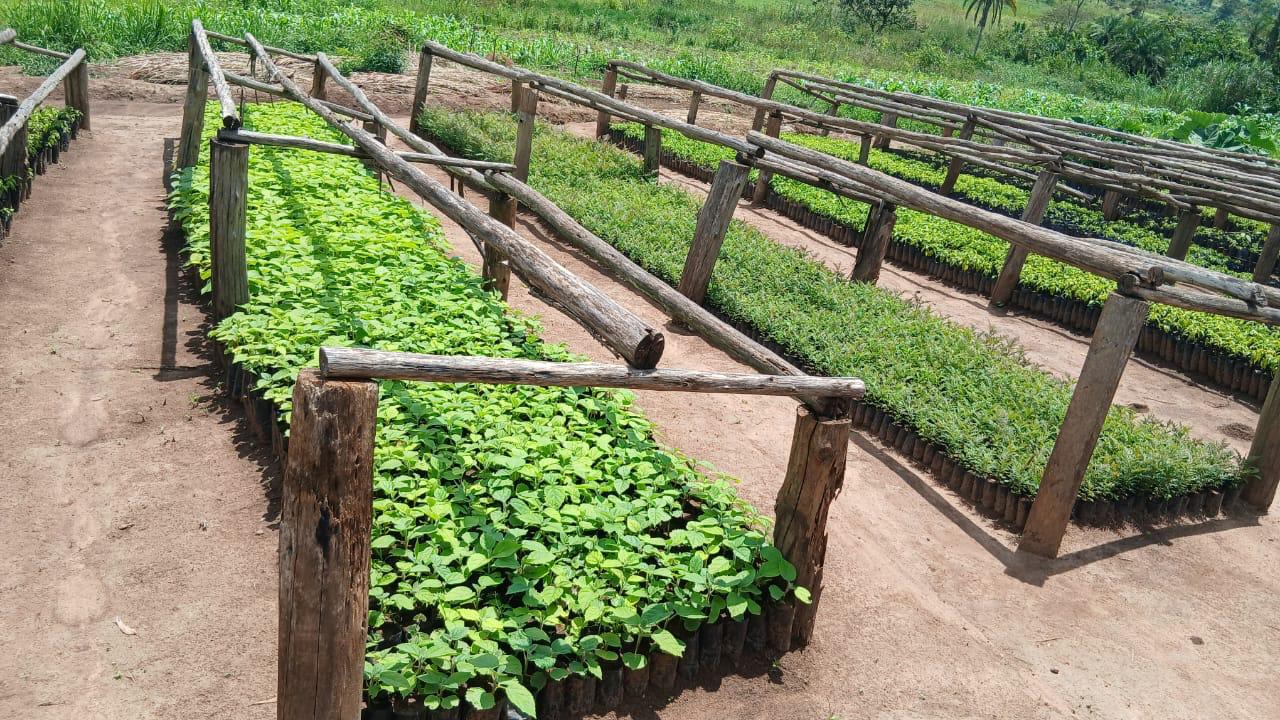
A community-based nursery raising high-quality indigenous tree seedlings from seed to field-ready plants, supporting local restoration and providing farmers with reliable planting materials.
Why the Nursery Exists
Every tree-planting effort is only as strong as the seedling it starts with. Across Uganda, a significant share of trees planted through restoration initiatives never survive their first dry season not because farmers fail to care for them, but because the seedlings themselves were never given a strong enough start. Weak seed sources, poorly developed root systems, and seedlings that haven’t been properly hardened for field conditions are among the leading causes of early tree loss. Our community nursery in Mparo exists to remove that risk entirely by controlling seedling quality from seed selection through to the moment a tree leaves for a farmer’s field.
The Process
Seedling production at Mparo follows a deliberate, multi-stage process. It begins with seed sourced from strong, healthy mother trees since seed from weak parent stock reliably produces weak seedlings, regardless of how well they’re subsequently cared for. From germination onward, seedlings go through a structured hardening process, gradually exposing them to the sun, wind, and temperature conditions they’ll face once transplanted, which significantly reduces transplant shock. Root pruning follows, encouraging a strong, fibrous root system rather than one that circles and weakens itself inside the potting bag. Finally, before any seedling leaves the nursery, it is graded and sorted, ensuring only vigorous, uniformly developed stock reaches the field — a step that alone meaningfully improves average survival rates once seedlings are planted.
Species Raised
The nursery focuses on indigenous and agroforestry-appropriate species suited to local conditions and farming systems — including Albizia coriaria and Cordia africana for cocoa integration, and Grevillea robusta for coffee farms — alongside other indigenous species selected for broader landscape restoration.
Community Employment
Beyond seedling production, the nursery has become a source of meaningful local employment. Day-to-day nursery work — potting, watering, root pruning, grading, and sorting — is carried out by young people from the surrounding community, several of whom were previously unemployed. Through this work, they are building technical skills in nursery management and seedling care, while earning a stable livelihood through green employment — work that restores the environment while directly supporting local household incomes.
Current Reach
The nursery has raised more than 15,000 seedlings to date, supplying quality planting material for our Cocoa Agroforestry Pilot and other ongoing restoration work, while continuing to expand production capacity ahead of future planting seasons.